







Choosing a site is one of the most important decisions in a commercial greenhouse project. A plot that appears large enough may still be unsuitable if it has poor road access, limited electricity, unreliable water, drainage problems, difficult ground conditions, or no room for future expansion.
Commercial greenhouse site selection should therefore be treated as an engineering and operating decision, not simply a land-purchasing decision.
This checklist helps growers, investors, and project developers compare potential sites before finalizing the greenhouse structure, irrigation system, climate-control equipment, and construction scope. The scoring example in this article is hypothetical and should not replace a local engineering survey.
Start With the Project Non-Negotiables
Before comparing sites, write down the requirements that cannot be compromised. These requirements should come from the crop plan, sales model, production target, and operating strategy.
A useful starting brief should include:
- the main crop or crop group;
- the intended production season;
- the approximate greenhouse area;
- the growing system, such as soil-based, substrate, NFT, or another hydroponic method;
- the expected level of climate control;
- the required water source and quality;
- the available electrical capacity;
- the expected delivery and installation schedule; and
- the possibility of future expansion.
Site selection should support the production objective. For example, a project that requires year-round production and intensive climate control will have different electricity, drainage, access, and building requirements from a seasonal structure with passive ventilation.
Before reviewing individual locations, read the commercial greenhouse project planning framework to connect site conditions with production goals and system configuration.
Use a Weighted Decision Matrix
When several sites appear possible, a weighted decision matrix helps prevent the decision from being based only on land price or visual appearance.
The following factors can be scored from 1 to 5:
- 1: major concern or significant additional work required;
- 3: workable but requires verification or mitigation;
- 5: strong fit with limited known risk.
The weighting should reflect the project. A site with excellent road access but insufficient power may still be unsuitable for a highly automated commercial greenhouse.
| Evaluation factor | Illustrative weight | What to review |
|---|---|---|
| Access and logistics | 15% | Road width, turning space, delivery route, crane access, and worker access |
| Electricity | 20% | Available capacity, connection distance, reliability, and backup-power options |
| Water supply | 15% | Source reliability, quality, storage, filtration, and seasonal availability |
| Drainage | 15% | Surface-water flow, discharge route, flood exposure, and internal drainage options |
| Climate exposure | 15% | Wind, snow, heat, rainfall, humidity, solar exposure, and extreme-weather risk |
| Ground conditions | 10% | Bearing capacity, settlement, groundwater, slope, and foundation complexity |
| Expansion potential | 10% | Available land, utility expansion, service roads, and future production zones |
The weights above are only an illustrative framework. The final weighting should be adjusted to the crop, climate, growing method, and business model.
Check Road Access and Construction Logistics
Greenhouse components, irrigation equipment, climate-control units, electrical materials, and construction machinery all need to reach the site safely.
Review the delivery route
Check the complete route from the nearest main road to the proposed greenhouse location. Important questions include:
- Can delivery trucks reach the site during the rainy season?
- Are there bridges, narrow turns, low clearances, or weight restrictions?
- Is there enough space for a truck to turn or reverse safely?
- Can long structural members be unloaded without damaging nearby property?
- Will construction traffic interfere with neighboring farms or public roads?
Confirm lifting and unloading space
The site should have a practical unloading and staging area. If cranes or lifting equipment are needed, confirm the ground stability, working radius, overhead obstructions, and safe distance from existing structures or power lines.
A site that requires extensive temporary road construction or difficult lifting operations may increase the installation scope and project schedule.
Verify Electricity Before Choosing High-Control Equipment
Electricity is often one of the most important site-selection constraints for a commercial greenhouse.
Depending on the design, the electrical system may serve:
- ventilation fans;
- cooling equipment;
- heating equipment;
- irrigation and fertigation pumps;
- water-treatment systems;
- lighting and blackout systems;
- automation controllers and sensors;
- packing, washing, and cold-storage equipment; and
- backup-power and safety systems.
Questions for the electricity provider
Ask for written confirmation of the available connection capacity, voltage, connection point, expected connection timeline, metering conditions, and any upgrade costs.
Also ask whether the supply is stable during peak demand periods. A site with nominal capacity may still require a power-quality review if sensitive controls, pumps, or climate equipment are planned.
Plan for critical loads
Not every electrical load has the same priority. The project team should identify which systems must remain available during a power interruption, such as alarms, controls, circulation pumps, ventilation, or emergency lighting.
The final backup-power arrangement depends on the equipment design, local regulations, operating risks, and required autonomy. Do not assume that one generator size is suitable for every greenhouse.
Evaluate Water Supply and Water Quality
A reliable water source is essential for both soil-based and hydroponic production. The water source should be reviewed for quantity, quality, seasonal reliability, storage, and treatment requirements.
Check source reliability
Confirm whether the source is a municipal connection, well, reservoir, surface-water source, or another supply. Record any seasonal changes, pumping restrictions, water rights, or local regulations.
Test the water before final design
Water-quality testing should be completed before the irrigation and fertigation system is finalized. Depending on the crop and system, the test may include:
- pH;
- electrical conductivity;
- hardness and alkalinity;
- iron and other minerals;
- suspended solids;
- microbiological indicators; and
- other local contaminants.
The test results can affect filtration, water treatment, nutrient management, pipe selection, cleaning frequency, and discharge planning.
Investigate Ground Conditions and Drainage
Ground conditions influence foundation design, construction cost, drainage, and long-term structural stability.
Ground-condition checklist
- Is the proposed building area reasonably stable?
- Is there evidence of previous settlement or filled ground?
- Does groundwater appear near the surface?
- Are there buried services, old foundations, or contaminated areas?
- Will the site require cut-and-fill work?
- Can construction equipment operate safely on the ground?
The appropriate investigation method depends on the site and the local engineering requirements. Do not publish or approve a fixed foundation solution before the ground conditions have been assessed.
Drainage checklist
Review how rainwater enters, moves through, and leaves the site. The assessment should include roof runoff, surrounding land, internal greenhouse drains, road surfaces, water-storage areas, and the final discharge route.
Check whether the site has experienced flooding, standing water, erosion, or blocked drainage during previous heavy-rain events. The drainage design should also consider future paved areas, packing buildings, service roads, and expansion zones.
Review Wind, Snow, Heat, and Solar Exposure
Climate exposure affects the greenhouse structure and the environmental-control system.
Wind exposure
Record the local design wind information and identify nearby features that may affect airflow, such as hills, buildings, trees, open fields, or coastal exposure. The structural design must be based on the applicable local standards and engineering review.
Snow and rainfall
Where snow is possible, the project should account for local snow loads, roof geometry, drainage, maintenance access, and potential wet-snow conditions. In high-rainfall regions, roof drainage, site discharge, corrosion protection, and access during storms become important.
Heat and solar exposure
Hot locations may require stronger ventilation, shading, cooling, insulation, water management, or humidity control. However, adding equipment without confirming the crop requirement and local climate may increase energy use without solving the underlying problem.
The site review should therefore connect climate data with the chosen crop, covering material, structure, ventilation strategy, and operating schedule.
Compare Expansion and Daily Operation Potential
A site can be suitable for the first greenhouse but unsuitable for the long-term farm plan.
Review whether there is space for:
- additional greenhouse spans;
- larger water storage;
- expanded electrical infrastructure;
- packing, washing, and cold-storage buildings;
- staff facilities;
- maintenance access;
- waste handling; and
- future crop or growing-system changes.
Also consider the daily working environment. A low-cost site may become expensive if workers must carry materials over long distances, if harvest vehicles cannot reach the packing area, or if clean and waste flows cross unnecessarily.
Hypothetical Comparison of Two Candidate Sites
Important: The following comparison is an illustrative planning example. Site names, scores, and weights are not real project data.
Assume two candidate sites are being reviewed for the same commercial leafy-green project. Site A has better electricity and road access but limited expansion area. Site B has more land and a stronger water source but requires road improvement and has more drainage work.
| Factor | الوزن | Site A score | Site B score |
|---|---|---|---|
| Access and logistics | 15% | 4 | 2 |
| Electricity | 20% | 5 | 3 |
| Water supply | 15% | 3 | 5 |
| Drainage | 15% | 4 | 2 |
| Climate exposure | 15% | 4 | 3 |
| Ground conditions | 10% | 4 | 5 |
| Expansion potential | 10% | 2 | 5 |
Using the formula below:
Weighted score = evaluation score ÷ 5 × factor weight
Site A produces an illustrative weighted score of 77 out of 100, while Site B produces 68 out of 100. This does not prove that Site A is the correct choice. It shows that the decision should be reviewed together with upgrade costs, schedule, permits, operational priorities, and risk tolerance.
A site with a lower initial score may still become the better choice if its weaknesses can be corrected at a reasonable cost. Conversely, a site with a higher score may be rejected if one critical issue, such as unavailable electricity or unacceptable flood exposure, cannot be mitigated.
Match the Site With the Greenhouse Structure
After the site has been evaluated, the project team can compare suitable greenhouse structures and covering options.
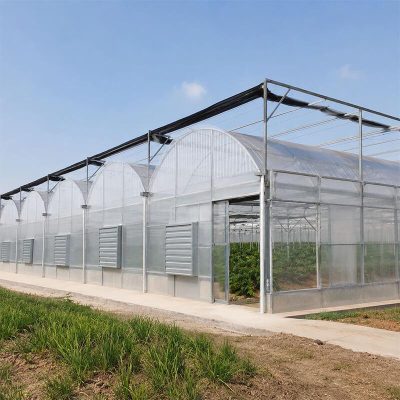
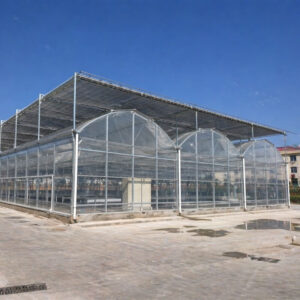
For larger commercial vegetable projects, review the commercial multi-span film tunnel greenhouse option together with the local wind, rain, snow, crop, irrigation, and expansion requirements.
The structure should not be selected from appearance alone. Confirm how it will support:
- the required growing layout;
- ventilation and climate equipment;
- irrigation and fertigation lines;
- internal service access;
- local structural loads;
- future automation; and
- maintenance and replacement work.
Prepare the Site Assessment Package
Before requesting a detailed configuration or quotation, prepare the following information:
- site location and coordinates;
- land boundary and available dimensions;
- photos and access-route video;
- topographic or survey information, if available;
- ground and drainage information;
- local wind, snow, rainfall, and temperature data;
- water-source and water-quality information;
- electricity details and backup-power expectations;
- crop, growing method, and production target;
- preferred greenhouse area and expansion plan;
- packing, storage, and delivery requirements; and
- installation, training, commissioning, and after-sales expectations.
If a detail is not yet known, write TBC rather than inserting an unverified number. This gives the supplier a clear list of items that must be confirmed before final design.

الخاتمة
A reliable commercial greenhouse site selection process examines more than land size. Access, electricity, water, drainage, ground conditions, climate exposure, workflow, expansion, and construction logistics all affect the long-term viability of the project.
The best site is not always the cheapest site or the largest site. It is the site whose risks can be verified, managed, and integrated into the greenhouse design and operating plan.
Use this checklist to compare candidate locations, then request a project-specific site assessment before finalizing the greenhouse structure, utilities, or quotation scope.
الأسئلة الشائعة
What is the most important factor when selecting a greenhouse site?
There is no single universal factor. Electricity, water, drainage, access, ground conditions, climate, and expansion should be assessed together. A critical problem in any one area can make the site unsuitable.
How much land is needed for a commercial greenhouse?
The required land depends on the greenhouse footprint, access roads, utility areas, drainage, packing space, staff facilities, and expansion plan. The greenhouse area alone should not be used as the total site requirement.
Can a greenhouse be built on sloped land?
It may be possible, but the feasibility depends on the slope, soil, drainage, cut-and-fill requirements, foundation design, and construction access. The appropriate solution must be confirmed through a site and engineering assessment.
Should water quality be tested before choosing the irrigation system?
Yes. Water-quality results can affect filtration, treatment, nutrient management, pipework, maintenance, and the final fertigation configuration.
Can a low-scoring site still be used for greenhouse production?
Possibly. A low score may identify problems that can be corrected through drainage, road improvements, utility upgrades, or revised planning. However, issues that cannot be mitigated should be treated as site-selection risks before purchase or construction.